Kashmiri Heritage
Kashmiri Walnuts (Akhrot): How to Choose, Store and Buy Them
Published on September 21, 2026
Why Kashmir Walnuts Are Worth Seeking Out
Jammu and Kashmir grows the large majority of India's walnuts. Most of the akhrot sold across the country, whether loose at a market or packed on a shelf, started on a tree in the valley. The harvest runs from September into October. The green outer husk splits, the nuts are gathered and dried, and they are then either sold in the shell or cracked and graded into kernels.
In Hindi a walnut is akhrot, and in Kashmiri it is doon. Our guide to Kashmiri dry fruit names has the rest.
In-Shell Walnuts or Kernels: Which Should You Buy?
This is the first choice to make, and it is mostly about how quickly you will eat them.
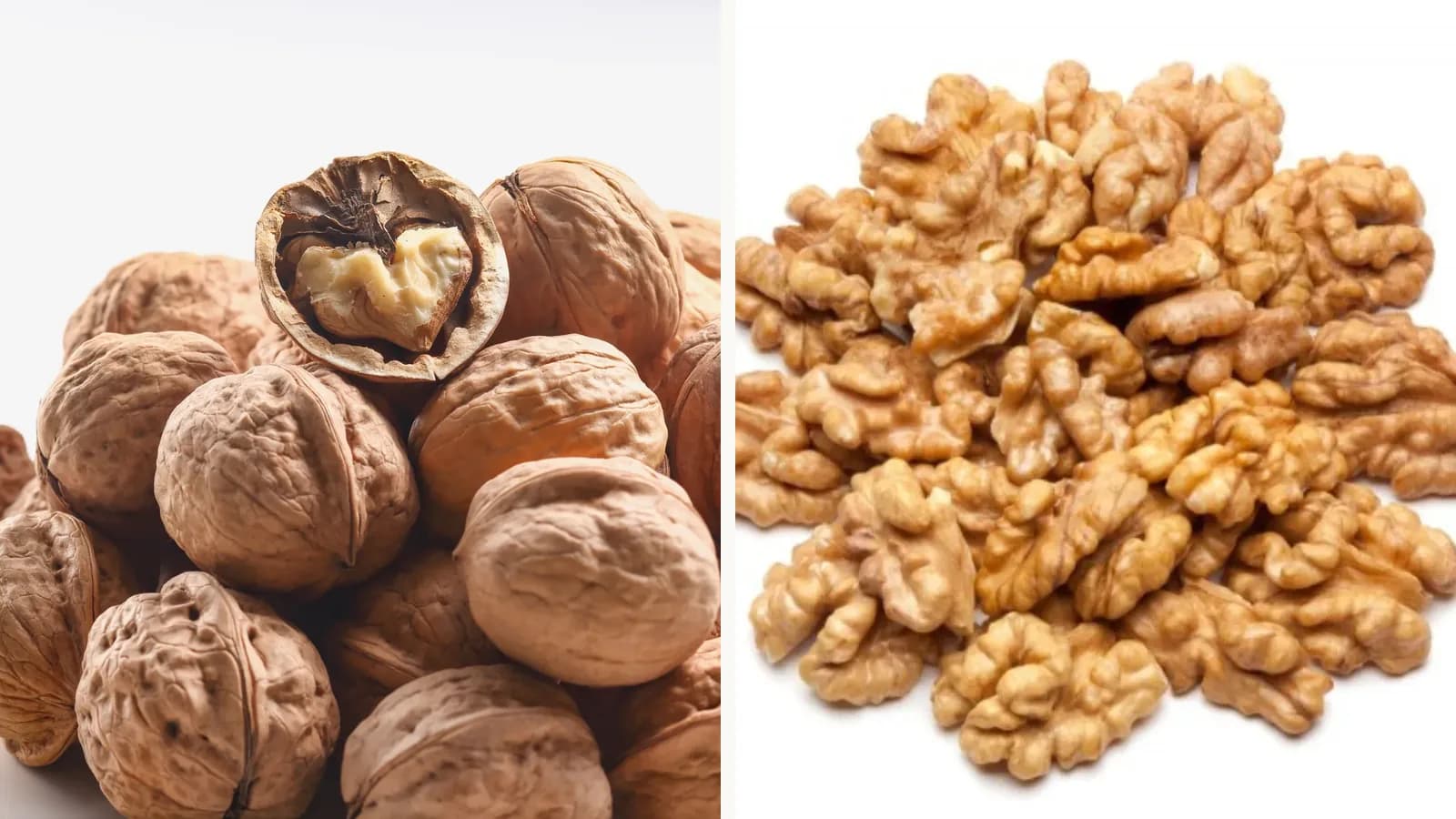
- Walnuts with shell keep longer. The shell protects the kernel from air and light, which are what turn walnut oil rancid. They suit you if you buy in bulk, eat a few a day, or want to crack them fresh. Kashmiri walnuts with shell are also the traditional choice for gifting and festivals.
- Walnut kernels are ready to use. They are the better buy for baking, breakfast bowls, chutneys and cooking, where cracking shells by the handful is a chore. Because the kernel is exposed, they need more careful storage (see below). Our extra light walnut kernels come as halves.
Thin-Shelled or Hard-Shelled?
Walnuts vary a lot in how hard the shell is. In India, thin-shelled walnuts are sold as kagzi (from kagaz, paper), because the shell cracks between your palms or with light pressure. Harder-shelled walnuts need a nutcracker, or a tap along the seam. Shell thickness tells you how easy the nut is to open. It does not tell you how good the kernel inside is.
What "Extra Light", "Light" and "Amber" Mean
Walnut kernels are graded by colour. The grades you will see most often, from palest to darkest, are:
- Extra light: pale cream kernels with the mildest, least bitter taste. This is the premium grade.
- Light: slightly darker, still mild.
- Light amber and amber: golden to brown kernels with a stronger, more tannic taste. They are fine for cooking, where the flavour is less noticeable.
Colour comes mostly from the thin papery skin on the kernel. Lighter kernels are usually from well-dried nuts that were handled well after harvest, which is why they cost more.
The other label to look for is the size of the pieces. Halves are whole kernel halves. Quarters and broken pieces cost less and are fine for baking.
How to Tell If Walnuts Are Fresh
Walnuts are high in oil, and oil is what goes off. A fresh walnut:
- smells mildly nutty, or of almost nothing
- snaps cleanly and tastes sweet-nutty with a slight bitterness from the skin
- has a kernel that fills the shell, not a shrivelled one
A rancid walnut smells like oil paint or old cooking oil and tastes sharply bitter. That bitterness does not go away with roasting or cooking, so throw rancid nuts out.
How to Store Walnuts
- In-shell walnuts: keep them in a cool, dry place in a breathable bag or a closed container. They keep for several months. In hot, humid weather, move them to the fridge.
- Walnut kernels: once the pack is open, keep them in an airtight container in the fridge. For longer than a couple of months, freeze them. They freeze well and do not need thawing before use.
- Keep both away from strong smells, such as onions and spices. Walnuts absorb odours.
How Many Walnuts a Day?
A common serving is about 30g, roughly seven whole walnuts or fourteen halves. Walnuts stand out among nuts for their plant omega-3 (ALA), which is one reason they are a popular daily handful. If you are following a specific diet, a nutritionist can tell you the right amount.
Ways to Use Kashmiri Walnuts
- A handful on their own, or with a few almonds and other dry fruits
- Soaked overnight, which softens them and mellows the skin's bitterness
- Crushed into Kashmiri akhrot chutney with curd, green chilli and mint
- Chopped into halwa, kheer, brownies and banana bread
- Toasted over salads and breakfast bowls
Buying Kashmiri Walnuts Online
When you buy online, check three things on the listing: whether the walnuts are in-shell or kernels, the colour grade for kernels, and the pack size against how quickly you will eat them. Buying a smaller pack more often gives you fresher walnuts than one large pack that sits open for months.
We sell walnuts with shell and extra light walnut kernels in 200g, 400g and 800g packs, delivered across India. Compare both, with today's prices, on our Kashmiri walnuts page.